

Take a moment to observe, the next time you're on the metro or in a park, these Parisians, book in hand, who indulge in a literary pause on their way to work or during a well-deserved break. The image is as charming as it is reassuring. Because around them, the vast majority are hunched over, neck bent at a right angle, faces glued to a bright screen, mindlessly scrolling through fleeting content, as easily forgotten as a “swipe” up.
The 2025 Barometer from the National Book Center (CNL) is clear: for another year, the figures for reading in France are declining. If, out of 1,001 people aged 15 and older surveyed, 56% consider themselves regular readers, this represents a decline.compared to 2023. Daily readers are also becoming fewer: 45% claim to read every day, which is a drop of four percentage points, with a average reading time of 31 minutes per day, against 3 hours and 31 minutes of screen time. Even more alarming: last year, there were more bookstore closures (85) than openings (83) in the capital — a first. While lack of time seems to be the main reason many French people are abandoning reading, many mention joining a book club (25%), attending literary events (24%), engaging in discussions on social media (23%), or meeting authors (44%) as motivations that could encourage them to read more. In the face of the decline of the book market, could literary events and, more broadly, collective experiences around reading be the key to rekindling a love for literature in France?
The Excitement of Literary Events for Their Social Dimension
The paradox has never been so striking: reading numbers are declining while literary events have never been so plentiful. For Stefania Tsakiraki, head of The Offline Club Paris, it's undeniably the social aspect that draws readers in. The club regularly organizes "reading parties" in parks or unusual spots around the capital. For an hour, everyone reads their book in silence before discussing it with others during the following hour. “Among the regular attendees, some tell me they can’t read at home anymore because there are too many distractions. Here, when they close their book, they have someone to exchange ideas and share their passion with ” she explains.
.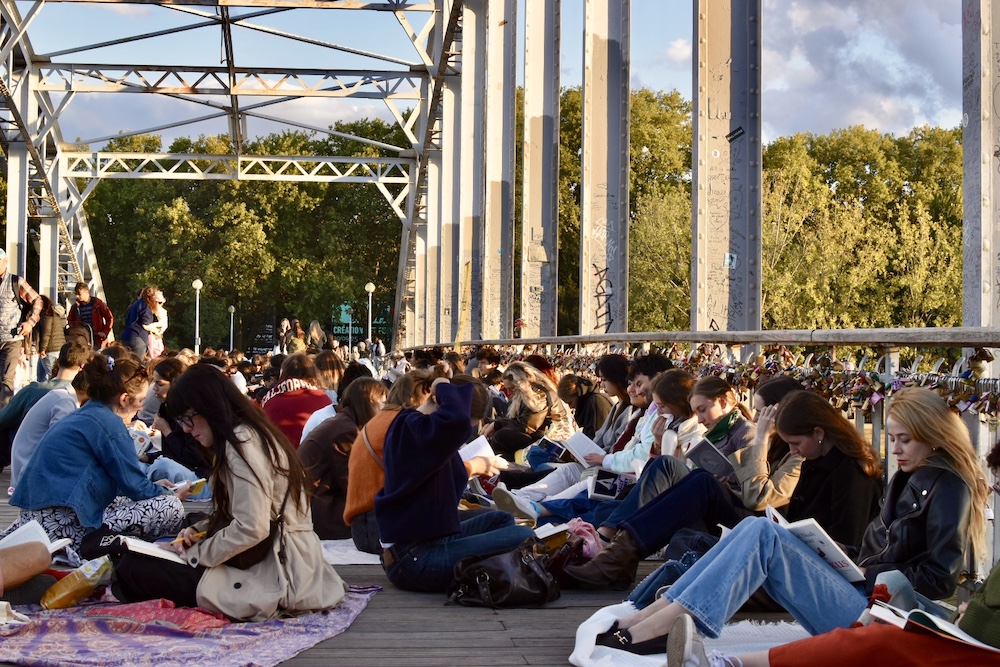
©The Offline Club
This idea of sharing is exactly what motivated Louise, 23 years old, to create a small-scale book club with members from her circle. They can be friends, simple acquaintances, or even complete strangers... In addition to allowing for engaging discussions and broadening one's culture, she believes that talking about books is a way to “create a stronger, more intimate bond ” with the people you meet. “Reading is very personal, you can get into someone’s head. It’s a great way to dig deeper, discover the book, and learn about the person. And then it removes a barrier.social expression because, no matter what happens, we always come back to the book», she asserts.
Every month, they define a broad theme. Each participant brings a book and shares what they liked — or didn’t — and how the book connects to the theme. « It’s a great way to reconnect with discussion, to create nuance and develop critical thinking », she points out. The result? After just a few sessions, the young woman has adopted a whole new way of reading. « Myreading is much less passive, but rather focused on different perspectives. Talking about it afterwards allows me to dive back into the book; there’s a real connection with the object, it’s not just consumption. They create lines of thought that I continue in my everyday life. »
From Social Media to Literature
On Instagram and TikTok, “Booksta” and “BookTok”—accounts dedicated to books—are everywhere! Recommendations, reviews… “It’s powerful in terms of discoveries. It’s wonderful that it’s becoming a community, even though it’s something very personal; it opens the door to a thousand and one discussions. It’s better for reading to spread rather than anything else ”, says Louise. However, the young woman wants to clarify her point: “But when brands or people with other interests take it over, that becomes a problem. ”
Can screens lead us to paper? That's what...
and suggest the latest data from the CNL. 78% of 15-19 year olds and 80% of 20-24 year olds believe that social networks encourage reading—although the average reading time for those under 25 is just 28 minutes a day, compared to an average screen time of 5 hours and 2 minutes. It’s precisely thanks to social networks that The Offline Club has been able to create true communities around the world since its inception in 2024. “The goal is to remind internet users that life beyond the screens is interesting and worth it. If there are 80 participants at an event, behind that, there are 500,000 people who can be inspired and who might pick up a book the next time they take the metro, instead of pulling out their phone,” reminds Stefania Tsakiraki. The next gathering is set for June 14, 2026.At the American Cathedral in Paris, for a moment of reading and creativity accompanied by live piano music, all without phones. Proof that the connection to beautiful stories might just depend on a moment of disconnection from screens.Voir cette publication sur Instagram