

For a long time, he was an unloved painter, judged as too cheerful by his peers who only believed in melancholic, disillusioned, ironic, or disenchanted painting. Yet it is precisely in happiness and love that all the modernity and power of Renoir's painting lies. And it is this very aspect of his work that will be honored at the Musée d'Orsay in just a few weeks.
Love, Always
« I know well that it is difficult to accept that a painting can be great art while remaining joyful», said Renoir. Quite paradoxically, however, and as a sign of his limitless talent, it...
the painter strived to do throughout his life, mainly depicting happy people, joyful scenes of life, creating vibrant and colorful paintings.See this post on Instagram
At the painter's place, love is not only the subject, it is also the vehicle for human relationships present on the canvas, and the embodiment of the perspective Renoir has on the world, on his models, and even more so on painting itself. To highlight this...vision, the Musée d'Orsay brings together here about fifty paintings from the early career of the artist, including some of his greatest masterpieces.
A Truly Modern Painting
But be careful, if love is the main theme of this first exhibition, it is far from presenting us with sentimental and mushy painting. On the contrary, this is precisely what makes the artist's modernity. To start, he represents all forms of love, whether friendly, familial, or romantic. Powerful bonds that he stages in everyday moments.
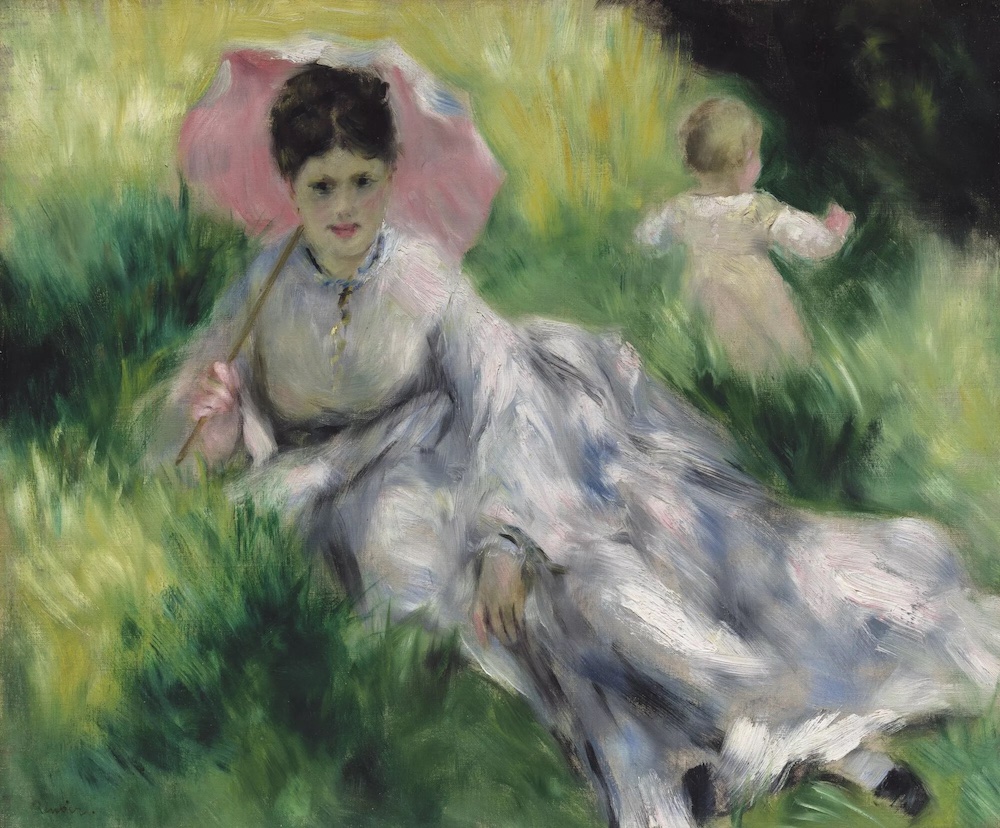
Auguste Renoir, Woman with an Umbrella and Child in a Sunny Landscape, 1874-1876 - Boston, Museum of Fine Arts, gift of John T. Spaulding, 48.593 Photograph © 2026 Museum of Fine Arts, Boston
Above all, he breaks free from the codes and rules of his time (following the principles governing his lifestyle), in order to highlight a certain freedom of morals and a gender equality, far from the violence that sometimes characterizes the relationships between men and women in that era. Like some of his contemporaries, he imagines a new painting, strong and vibrant, embodied by the most powerful of feelings.
The Thousand Facets of Renoir
At the same time, the institution invites you to discover another aspect of Pierre-Auguste Renoir's work: his 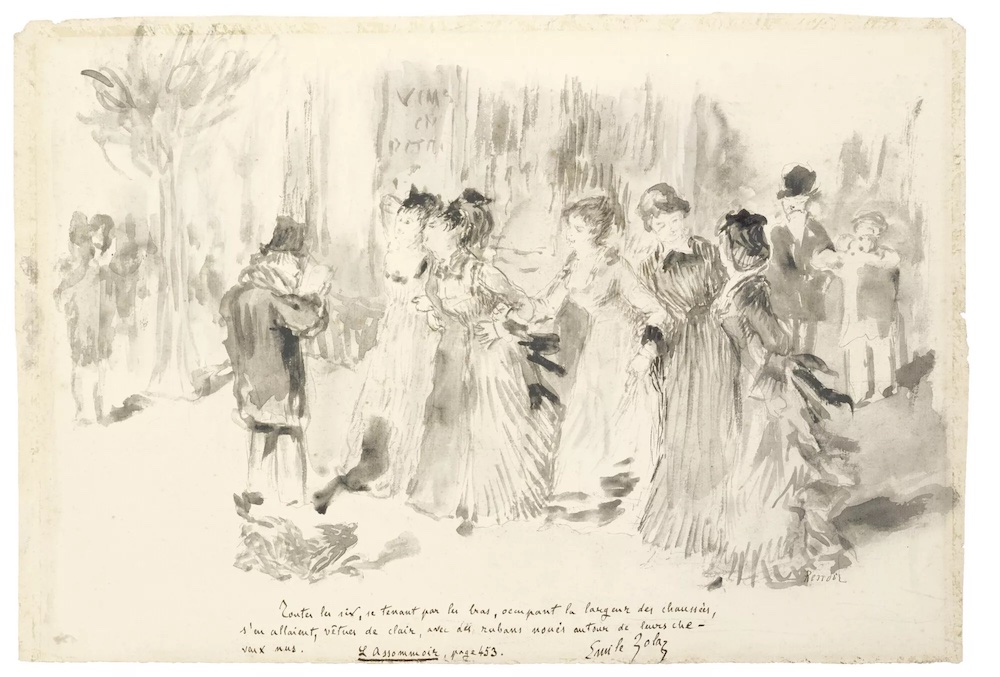
Auguste Renoir, The Daughters of Workers Strolling on the Outside Boulevard (illustration for L'Assommoir by Émile Zola, illustrated edition, Paris, C. Marpon et E. Flammarion, 1878), 1878 - Collection Jean Bonna, D 677. Photo: © Geneva, collection Jean Bonna/Photography: Patrick Goetelen, Geneva
For nearly 4 months, the Musée d’Orsay invites you to dive into this lesser-known part of Renoir’s work, creating a dialogue between his paintings and drawings, where the connections become quite clear from the 1880s onward, as the artist somewhat distances himself from the Impressionist movement. This exhibition offers a true immersion into the creative intimacy of the painter, showcasing uHundreds of sheets, some of which are never before shown !
Renoir and Love. The Happy Modernity (1865-1885)
From March 17 to July 19, 2026
More info
Renoir the Draftsman
From March 17 to July 5, 2026
More info
Musée d'Orsay Esplanade
Valéry Giscard d'Estaing – 7th