

In Lyon, few neighborhoods can boast such a long toponymic history. Nestled in the 9th arrondissement, between Vaise Lyon and the hill of Fourvière, Gorge de Loup appears in black and white as early as 1493 in tax documents preserved at the Lyon Municipal Archives. This rare continuity intrigues, especially when so many other neighborhoods have changed names over time. Here, there’s no rebranding: Gorge de Loup remains Gorge de Loup, period.
From a Bucolic Hollow to an Industrial Neighborhood
Before becoming an urban hub, Gorge de Loup was a beloved green space at the city’s edge. As early as the 16th century, the area attracted the elite.
Yes, just like François de Biny, a merchant-banker who had a villa built there between 1515 and 1538. At that time, the landscape was made up of meadows, hills, and elegant mansions. But the rural charm gradually gave way to a more industrial reality: slaughterhouses, gas works, factories… A radical transformation that the historian Léon Galle would describe with a touch of nostalgia at the beginning of the 20th century..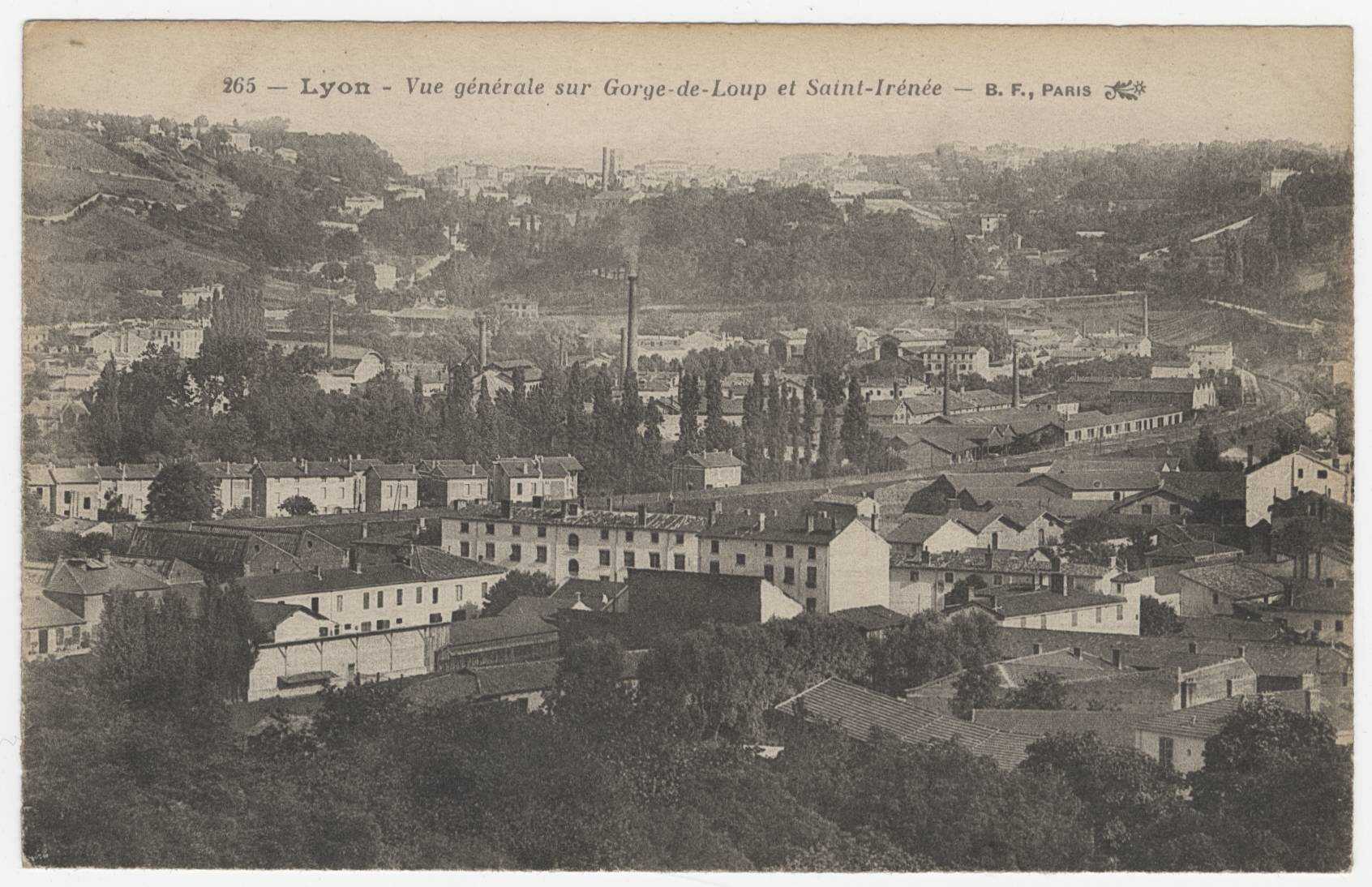
A general view of Gorge-de-Loup and Saint-Irénée. © Municipal Archives of Lyon
Contrary to what its name might suggest, no wolf has officially claimed its identity in the neighborhood. One theory proposed by the German traveler Abraham Gölnitz mentions a nymphaeum whose shape resembles a "wolf's throat." The problem? The name already existed before this architectural feature was built. An alluring explanation, but a bit out of sync.
Between historical clues and local folklore
Historians today prefer more down-to-earth hypotheses. One mentions an old family named "Loup" that may have owned land in the area.the area. Another possibility, more geographical, refers to the very nature of the place: a wetland, regularly flooded by the Saône. Some ancient texts even mention "Gorge de Vacques," which means a hollow or empty area. Finally, the word "lou," which could mean "water" in an old dialect, would strengthen this idea of a valley linked to water rather than to animals. Today, Gorge de Loup no longer evokes wolves or marshes, but a neighborhood well rooted in Lyon's life. Train station, metro station, park and ride... the name is everywhere, integrated into everyday language. And perhaps that’s its greatest strength: having crossed the centuries without losing any of its uniqueness.
Source: Tribune de Lyon