

You could walk past it a hundred times without suspecting what lies behind. At 60 rue Gustave-Delory, a vaulted opening discreetly slips between the façades and leads toward a narrow cobbled street lined with old houses. Welcome to the Cour des Brigittines, one of the last remnants of the old Saint-Sauveur neighborhood. A little piece of Lille miraculously preserved from the major demolitions of the twentieth century, whose peaceful appearance hides a distinctly more turbulent history. Because in the early seventeenth century, the convent that stood here found itself at the heart of a spectacular case of demonic possession and exorcism.
A hidden little street behind a 1673 portico
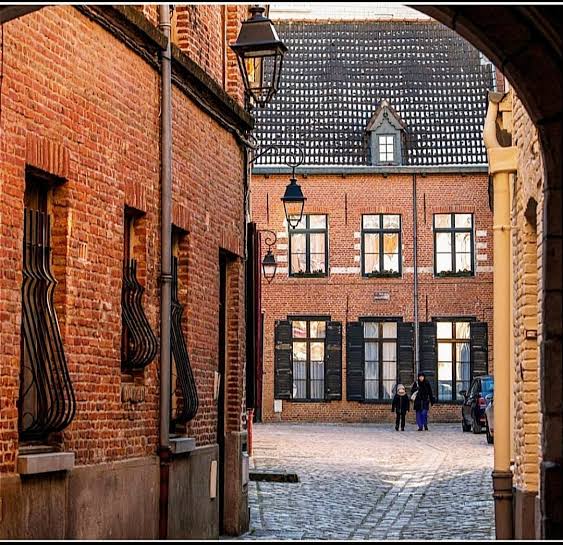
Before talking about the devil, you first have to find the place. The Cour des Brigittines hides behind a vaulted passageway dating from 1673, accessible from rue Gustave-Delory. Behind it appears a narrow little street that gradually widens, surrounded by
row of brick houses reminiscent of the architecture of the old beguinages. The whole complex once formed the interior courtyard of a convent. Its name comes from the religious sisters of the Order of Saint Brigitte, established in Lille at the beginning of the 17th century. The community was founded in 1604 by Anne Dubois, a native of Lille who had previously been a sister with the Brigittines of Termonde, with the support of Nicolas de Montmorency. Anne Dubois then returned to Lille accompanied by three religious sisters. A few years later, the atmosphere at the convent took on a rather unsettling turn.In 1612, strange crises shook the convent
The first disturbances are said to have begun as early as 1608, before taking on a much greater scale in 1612. The accounts preserved about the affair describe religious sisters seized by convulsions and violent fits of rage. At Pentecost in 1612, some reportedly shouted, overturned their superior, and even danced on the altar. One sister, Marie de Sains, eventually declared herself possessed by the devil. We were then in a Europe deeply marked by beliefs surrounding the demon andof witchcraft. The behaviors of the nuns were therefore interpreted through this religious lens. And rather than prescribing a few days of rest for everyone, the 17th century had another specialty: they would call in exorcists.
A nun finally confesses to witchcraft
After an initial ecclesiastical procedure that led nowhere, two exorcists are called in. It's during this period that the affair becomes particularly dark. Subjected to interrogations and exorcisms, Marie de Sains eventually makes spectacular confessions: she claims to have made a pact with the devil, presents herself as a sort of leader of witches, and recounts participating in sabbaths with other nuns. Stories that should be taken with enormous skepticism four centuries later. The sources relating to the affair emphasize that these confessions largely reflect the beliefs, obsessions, and methods of exorcists of the time, rather than any proof of supernatural practices. The affair nonetheless gains enough momentum to far exceed the walls of the small Lille convent. High ecclesiastical authorities intervene, notably apostolic nuncio Guido Bentivoglio, the pope's representative in the Spanish Netherlands. His intervention contributes fifinally exonerated the convent chaplain, who himself had been accused of bewitching certain nuns, and put an end to the crisis. So we were quite far from the peaceful daily life that the little courtyard suggests today.
The convent disappeared, but its courtyard survived
The history of this place doesn't end with that strange affair. The Brigittines convent lasted for nearly two centuries before disappearing at the end of the 18th century. A large part of its buildings was notably destroyed during a fire during the Austrian siege of Lille in 1792, and then the land of the former religious complex was gradually divided up and sold off. The courtyard, however, survived. And it's almost a small miracle when you know the history of Saint-Sauveur. Starting in the 1950s and especially in the 1960s, a massive urban renovation operation led to the destruction of much of this old working-class neighborhood in Lille. Entire streets disappeared under the bulldozers. The Brigittines courtyard was among the rare ensemblewere preserved. Even today, it stands at the heart of the only old neighborhood preserved in Saint-Sauveur, alongside a few other historic buildings in the area.
One of the most secret passages in the heart of Lille
More than four centuries after these events, there's not a single possessed nun to report behind the archway—which is rather reassuring for the neighborhood. Instead, you'll discover a surprisingly peaceful little street, with its brick facades, cobblestones, and charming old passageway that stands in stark contrast to the wide Gustave-Delory street just ahead. The Lille Archives already described it as "a peaceful haven, an island frozen in time", noting in passing that the convent's mysticism had once veered into witchcraft. A discreet setting, a frankly dark history, and a remnant of a Lille neighborhood almost entirely vanished: as autumn approaches, it's hard to find a better little tale to share while wandering down a street.