

Every year, this ranking is closely watched by locals, elected officials, and anyone dreaming of a change in their living environment. Vibrant cities, human-sized communities, and evolving metropolises: the list of the cities where life is good reveals the new preferences of the French. And once again this year, the results offer some interesting insights.
Biarritz, still at the top
For the second consecutive year, Biarritz claims the top spot among cities with over 2,000 residents where the quality of life is considered the best. The coastal city in the Basque Country outshines Annecy and Angers, two cities frequently praised for their balance between urban dynamism and natural surroundings. Biarritz’s success is no coincidence. With its ocean views, rich heritage, cultural offerings, and quality infrastructure, the city ticks many boxes. It also enjoys an attractive image that combines a wonderful way of life, a privileged environment, and local economic vitality. This delightful mix appeals to both residents and newcomers alike. More broadly, the
The ranking highlights the great performance of cities in the West and along the coast. Bayonne takes 4ᵉ place, Anglet comes in at 7ᵉ, while Nice holds the 9ᵉ position, confirming a steady rise over the years.Lille well-placed in the North, more understated on the national level
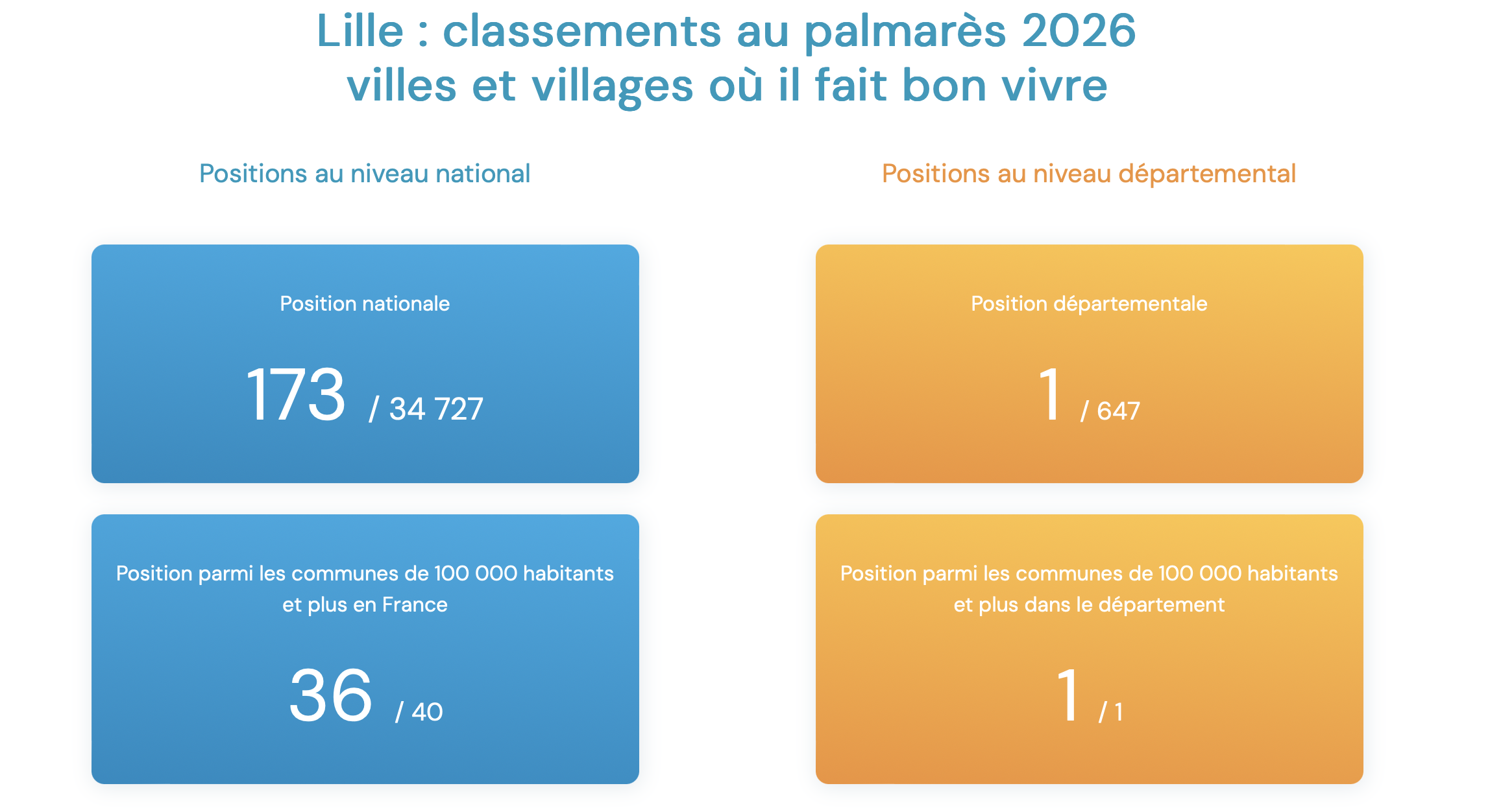
In the 2026 national ranking, Lille is positioned at 173ᵉ place out of 34,727 French municipalities. This ranking might come as a surprise considering its status as a major metropolis, but it also reflects the increased demands placed on large cities. On a departmental scale, however, the capital of Flanders stands out as a reference: Lille takes 1ʳᵉ position in the North, ahead of all other municipalities. It also ranks 36ᵉ out of 40 among French cities with over 100,000 inhabitants, confirming a solid yet contrasting positioning.
An attractive metropolis, with its challenges
While Lille may not be at the very top of the national rankings, it still has plenty of strengths. Economic dynamism, a vibrant cultural scene, a significant student population, and a well-connected transportation network continue to make it strong.
But like many big cities, Lille also faces several challenges: housing pressure, perceptions of safety, saturation of certain services, and growing expectations from residents in terms of quality of life and environment. These factors weigh heavily in this type of ranking.
A ranking based on nearly 200 criteria
This national ranking is based on 197 criteria divided into 11 main categories: quality of life, safety, health, transportation, commerce, environment, solidarity, real estate attractiveness, and public services. The data comes from various sources.
d’organisms like Insee, ministries, Arcep, and the European program Copernicus, are combined with an OpinionWay survey measuring the priorities of the French. Unsurprisingly, quality of life takes the lead in concerns, closely followed by security and health. These themes have become central in residential choices, explaining why many medium-sized cities perform well at the top of the rankings.Lille faces increasingly strong competition
While Lille confirms its status as a flagship city in the North, the 2026 rankings remind us of one thing: competition between territories is more intense than ever. Expectations are evolving, comparisons are multiplying, and large metropolitan areas must constantly adapt to remain attractive. This ranking should be viewed as a snapshot, more than a definitive judgment, but still provides valuable insights into what the French are looking for to live well.